
Shadow Reduction in Ultrasound Imaging using Radiance Field Decomposition
RFlash: Radiance Field for Light-adaptive Shadow Reduction
Correspondence: Valentin Bacher
Under Review · 2026

Abstract
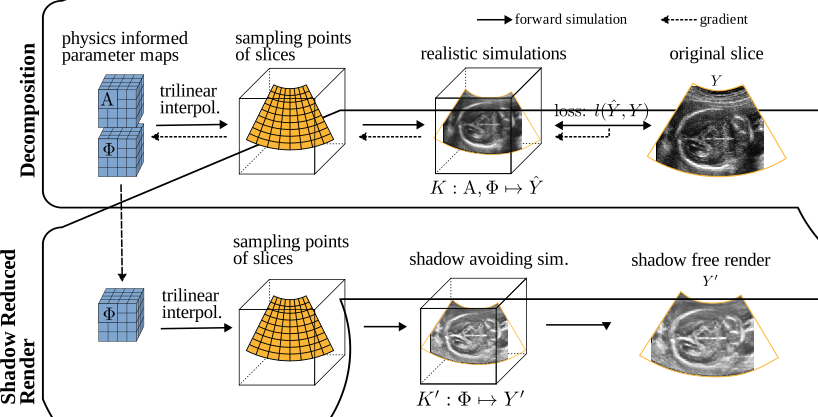
Acoustic shadows can hide clinically relevant structures in ultrasound images, especially in fetal brain scans where the skull attenuates the signal before it reaches deeper anatomy. RFlash is a physics-informed post-processing method that reduces these shadows without requiring scanner hardware access. It decomposes an ultrasound image into attenuation and scatter maps, then uses a differentiable ultrasound simulator to render a shadow-reduced image.
Across fetal brain and abdominal ultrasound data, RFlash improves visual contrast consistency and reduces shadow-related intensity differences compared with the original images and a classical Hughes baseline. The same decomposition also produces shadow confidence masks that can support downstream shadow segmentation.
Overview
Ultrasound is portable, low risk, and widely used, but acoustic shadows can obscure anatomy behind highly attenuating structures such as bone. In fetal brain imaging this can make the proximal hemisphere harder to assess, limiting the visibility of bilateral structures that are clinically important.
RFlash treats shadow reduction as an image-formation problem. Instead of learning a direct image-to-image correction, it estimates physically meaningful maps that explain how ultrasound energy is attenuated and scattered through tissue. A shadow-reduced rendering can then be interpreted as virtually moving the probe through the tissue so that each depth depends less on structures closer to the transducer.
Methods
RFlash optimises explicit attenuation and scatter-intensity maps so that a differentiable ultrasound simulator can reproduce the input image. After this decomposition, the simulator renders a second image with the shadow-forming attenuation effect reduced. This keeps the method tied to ultrasound physics while remaining usable as post-processing on already beamformed images.
Results
Fetal brain: Original vs RFlash
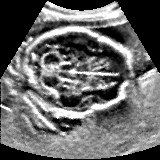 RFlash
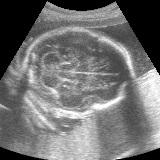 Original
Fetal brain: Hughes vs RFlash
RFlash
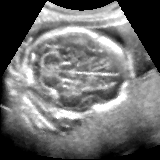 Hughes
Abdominal ultrasound: Original vs RFlash
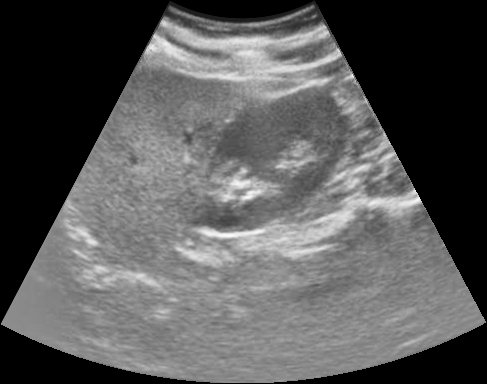 RFlash
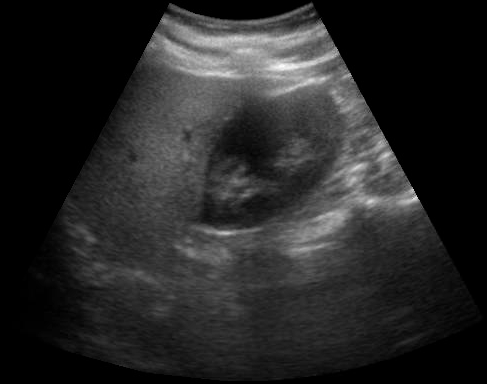 Original
Abdominal ultrasound: Hughes vs RFlash
RFlash
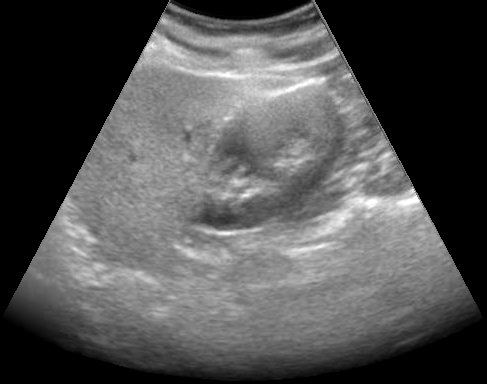 Hughes
Drag each slider to compare the original or Hughes-corrected image with RFlash.
Age Prediction
To test if the recovered structures from the proximal hemisphere are clinically useful, we trained a deep learning model to predict gestational age from the proximal hemisphere on normal ultrasound data and shadow reduced data. We tested on both hemisphere and found that shadow-reduction improves predictability, with the largest improvements of the predictability of the proximal hemisphere.
Shadow Masks
The sliders below compare shadow mask from Meng et al. overlaid with the confidence masks derived from RFlash.
Shadow mask example 04
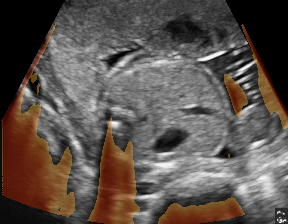 Ours
Ours
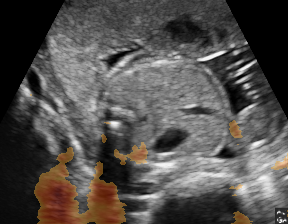 Quinn
Quinn
Shadow mask example 07
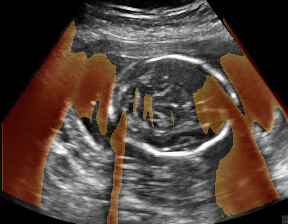 Ours
Ours
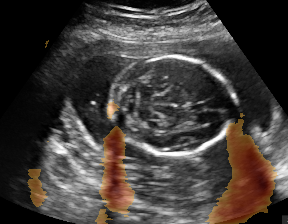 Quinn
Quinn
Shadow confidence overlays from Quinn compared with RFlash.
Cite
BibTeX
@misc{bacher2026shadow,
      title={Shadow Reduction in Ultrasound Imaging Using Differentiable Simulation and Radiance Field Decomposition},
      author={Valentin Bacher and Pak Hei Yeung and Bernhard Kainz and Madeleine K. Wyburd and Nicola K. Dinsdale and Michael Gray and Ana I. L. Namburete},
      year={2026},
      month={9},
      eprint={2609.29373},
      archivePrefix={arXiv},
      primaryClass={cs.CV},
      url={https://arxiv.org/abs/2609.29373},
}